After finishing a few weeks with a client — which had involved some of the more profound conversations I’ve had in the sobriety space — he asked me something I had thought deeply about for years.
“Is sobriety for everyone?”
I’ve mentioned throughout our newsletters and posts that, for me, my renewed alliance with my straight edge roots supports the belief that the world would be better without substances. At least, that’s how I see it.
Like anything though, I didn’t want to give a bullshit answer that wasn’t real, so I simply said:
“I don’t know.”
I sat on the plane on the way home and, in the days that followed, the question continued to bother me.
On one hand, I genuinely believe in this way of life. On the other, after some deep reflection, I realised the real question wasn’t whether sobriety is for everyone.
The real question was:
Should sobriety be a forced belief system?
To that, my answer is a hard no.
Even then, it’s complicated.
Over the next few paragraphs, I’ll work through my thought process.
Is Sobriety For Everyone?
No.
We all know that person. The friend or family member who can have one drink and leave it there. No obsession. No chaos. No consequences. Lucky them, I say.
For those people, sobriety may not be necessary.
But that answer depends entirely on what you believe sobriety actually is.
For some people, sobriety simply means not drinking, not using drugs, or not gambling. For me, it’s become much bigger than that.
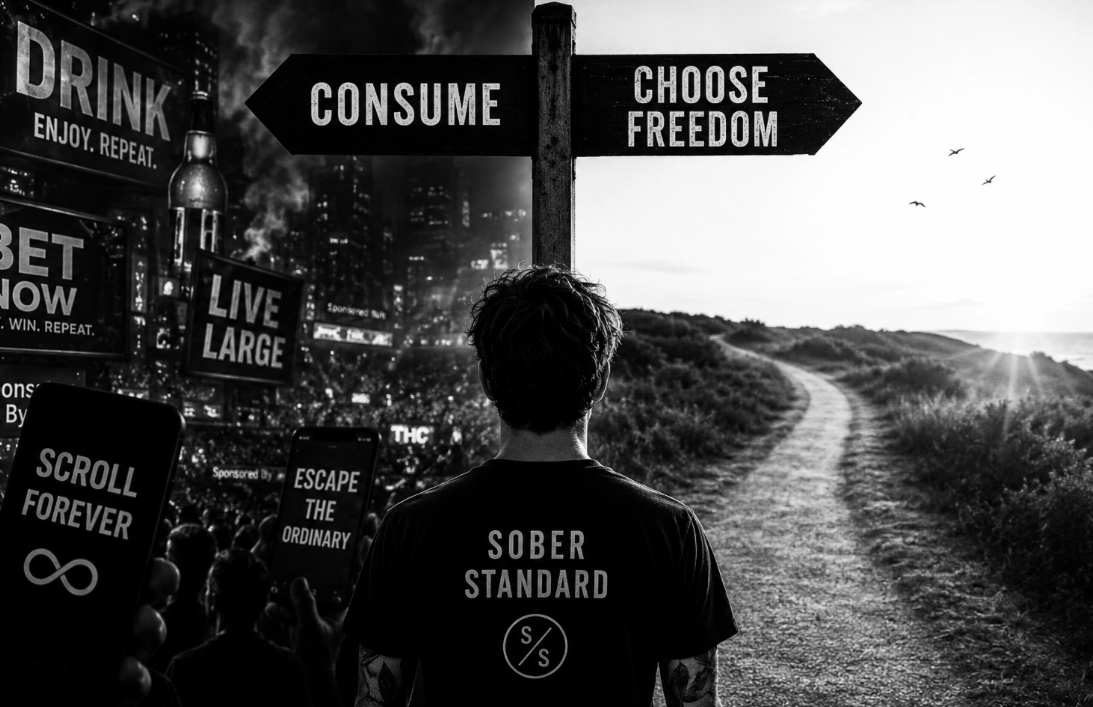
It’s about how addiction and consumption sit within modern society.
We’ve come a long way from the days when advertising wasn’t shaping culture. To pretend it doesn’t influence us now is simply being blind to reality. If you’re connected to technology, sport, media, entertainment, or social platforms in any way, you’re constantly being sold something.
We’re surrounded by alcohol marketing, gambling promotions, sports sponsorships, and increasingly the normalisation of drug use.
We’ve created a culture where addiction is often packaged as lifestyle.
I’ve written before about the influence of alcohol and gambling advertising in sport, and it’s difficult to ignore how deeply these industries have embedded themselves into everyday life.
So in that sense, sobriety isn’t just for people in recovery.
Sobriety is for corporate media.
Sobriety is for technology companies.
Sobriety is for sporting organisations.
Sobriety is for anyone willing to stop and ask whether constant consumption should really be the default setting of modern life.
But when people say “sobriety is for everyone,” I don’t think that means everyone should be forced to live sober.
I think it means sobriety should be available to everyone who needs it.
It means there should be a voice pushing back against the cultural shift that has normalised excessive drinking, gambling, and other addictive behaviours.
It means there should be an alternative.
A reminder that you don’t have to participate simply because everyone else is.
So if I was asked the question again today, my answer would probably be this:
No, sobriety isn’t for everyone.
But sobriety as an idea is for everyone.
Not as a mandate.
Not as a belief system.
Not as something imposed on people.
Simply as an option.
A perspective.
A counterweight to a culture that increasingly profits from addiction.
What people do with that option is up to them.

Author: Carter Davies
Music, Travel and Sobriety writer for Sober Standard. More articles can be found here and on X https://soberstandard.com/profile/carter-davies/
One response to “Is Sobriety For Everyone?”
Thank you for the read. I resonate with this. It helps.