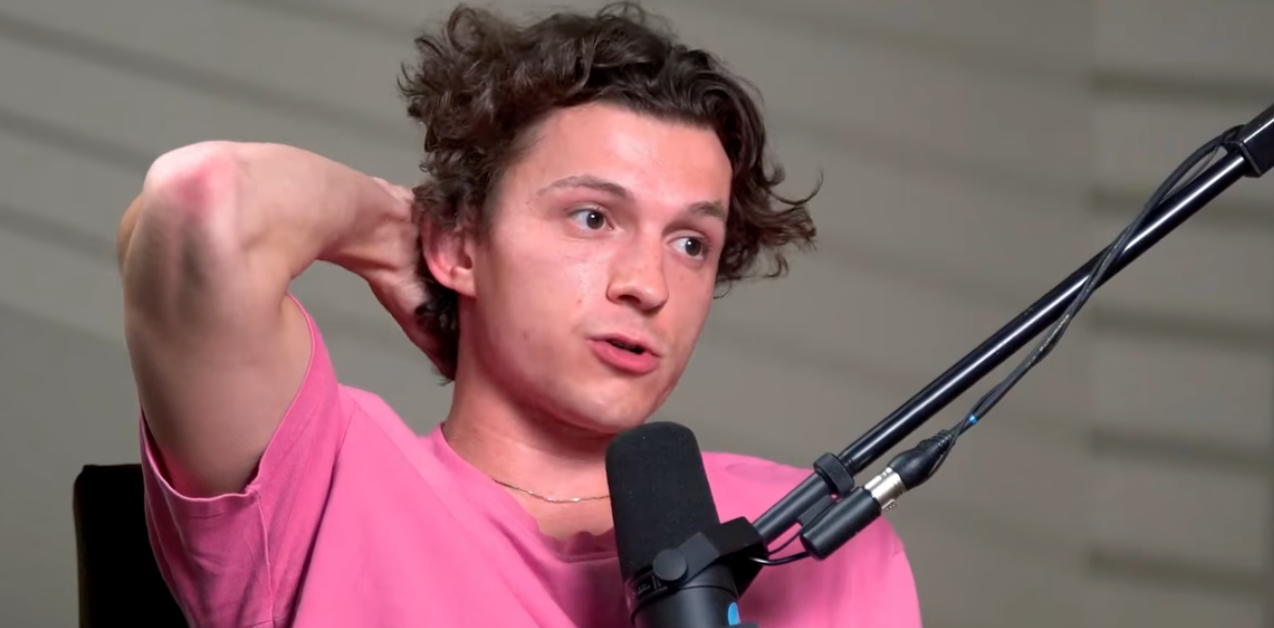
The Clock-Watcher:
Tom Holland’s Accidental Road to Sobriety
He didn’t plan to quit. He just did a Dry January — and then couldn’t stop thinking about a drink. That thought alone changed everything.
January 2022. Tom Holland — Spider-Man, one of the most famous twenty-somethings on the planet, fresh off a film that had just earned nearly two billion dollars at the box office — woke up on a January morning and started checking the clock. Not because he had somewhere to be. Because he wanted a drink, and he’d promised himself he wouldn’t have one until noon. He was doing Dry January. He was twenty-five years old. He was, in his own words, scared.
“All I could think about was having a drink,” he told Jay Shetty’s On Purpose podcast in July 2023. “I was waking up thinking about it. I was checking the clock — ‘when’s it 12?’ — and it just really scared me.”
That’s it. That’s the whole origin story. Not a car accident, not a hospital visit, not an intervention from friends and family. Just a man lying in bed on a Tuesday morning in January, watching the minutes tick by, and noticing — perhaps for the first time — how much real estate in his mind alcohol had quietly taken up permanent residence in.
What he did next — the month-by-month logic, the goalpost-shifting, the gradual revelation of what had been buried underneath all those drinks — is worth sitting with slowly. Because Tom Holland’s path to sobriety is one of the most useful roadmaps available for a very specific kind of person: someone who by every external measure has their life together, and who is only starting to suspect that the drinking isn’t part of that picture.
The full video at the centre of this piece: “Tom Holland’s Sober Journey: Finding Freedom and Fulfilment” — watch it before you read on. The Jay Shetty podcast interview is also available in full, and it remains one of the most honest conversations about functional dependency that exists in the public record.
The Boozy December and the Thought That Wouldn’t Leave
Holland has been refreshingly precise about the context. He told the Rich Roll podcast in late 2023 that he’d had a “very, very boozy December” — Christmas, vacation, a lot of drinking — and that, like a lot of Brits, he’d decided to use Dry January as a reset. Nothing dramatic in the intention. No grand plan. “I’ve always been able to drink a lot,” he said. “I think I get that from my mum’s side.” He wasn’t worried. He was doing a month-long challenge, the way millions of people do every year in the UK, most of whom get through it without much incident and then have a drink on February 1st and forget about it.
Except Holland couldn’t stop thinking about the drink.
This is the part of the story that cuts through the celebrity noise and lands somewhere universal. Not because he was drinking himself into chaos — he explicitly says he didn’t consider himself “a bad drunk” — but because the mental effort of not drinking turned out to be far larger than he’d expected. The craving wasn’t physical, exactly. It was more like a constant low-frequency hum in the background of every other thought. The clock-watching. The awareness of alcohol’s absence as a presence in itself.
If you’ve ever tried to take a break from drinking and found that you spent a large portion of that break thinking about drinking, you’ll recognise this immediately. We’ve written about mental real estate before — the cognitive bandwidth that a habitual drinking pattern consumes, often invisibly, until you try to reclaim it. Holland bumped into this phenomenon head-on in January 2022 and was honest enough with himself to call it what it was: a warning sign.
“I couldn’t quite wrap my head around how much I was struggling without booze in that first month,” he said. “And it really scared me.”
The Punishment Game — and How a Goal Became a Revelation
Most people who have a bad Dry January stop at the end of the month, pour themselves a glass, and quietly file the difficult feelings under “weird, but fine now.” Holland did something different. He decided to extend it — not because he felt ready, but specifically because he felt unready. He called it, with a kind of bleak self-awareness, a “punishment.”
“I decided, as a sort of punishment to myself,” he told Jay Shetty, “that I would do February as well as January.”
February was harder. He started to panic — “Damn. I have a bit of an alcohol thing.” He had a conversation with his doctor about his liver that pushed him further. Then March came, and he started to feel, incrementally, slightly better. Slightly less like he was fighting something. And here the logic of the whole journey crystallises into something that’s genuinely useful as a roadmap: rather than committing to sobriety forever — a prospect that to most drinkers feels either impossible or simply too large to compute — he gave himself a milestone.
“If I can make it to June 1st, which is my birthday, and I can do six months without booze, I will have then proved to myself that I don’t have a problem. I’m just young and enjoying a drink.” — Tom Holland, Rich Roll Podcast, 2023
The genius of this framing is almost accidental. He wasn’t committing to sobriety. He was committing to a test. A hypothesis. I want to prove I’m fine — which is exactly the logic that gets a lot of resistant drinkers to try something they’d never try if it was framed as a permanent life change. This kind of time-limited challenge is one of the most evidence-backed entry points into lasting change, and Holland arrived at it completely intuitively, driven by the simple desire to prove something to himself.
He made it to June 1st. His birthday. Six months. And what he found on the other side wasn’t triumph, exactly, or even vindication. It was something quieter and considerably more powerful.
“By the time I got to June 1st, I was the happiest I’ve ever been in my life.” — Tom Holland, On Purpose with Jay Shetty, 2023
- December 2021A particularly heavy holiday period prompts a reset decision.
- January 2022Dry January begins. Clock-watching, mental struggle, and a realisation that something is off.
- February 2022Extended as “punishment.” Harder, not easier. Doctor’s conversation about liver health.
- March 2022Slight improvement begins. Goal set: make it to June 1st birthday.
- June 2022“Happiest I’ve ever been.” The test becomes a choice to keep going.
- January 2023One full year. “I’m never going to drink again. This is the best version of myself.”
- October 2024BERO non-alcoholic beer launches at Target. Now in 3,000+ stores.
- January 2026Three years sober. BERO approaching $10 million in first-year sales, projecting 3x growth.
The Performance Edge — Sleep, Clarity, and the Set That Changed
For a section of the population, the most persuasive argument for sobriety isn’t emotional or spiritual — it’s operational. And Holland, who was in the middle of a relentless schedule of filming and press and the particular pressures of being a marquee franchise actor in his mid-twenties, discovered the performance benefits of not drinking in real-time, on set, in ways that were impossible to ignore.
Sleep was the first thing. Alcohol’s effect on sleep quality is one of the most misunderstood aspects of drinking culture — the widespread belief that alcohol helps you sleep is technically true in the sense that it accelerates the onset of unconsciousness, but it significantly degrades sleep architecture, suppressing REM sleep and increasing nighttime waking. Holland found this out empirically, through a sleep-tracking ring. The data was unambiguous: even when he was otherwise doing everything right — fourteen-hour workdays, two hours in the gym — the drinking was quietly undermining his recovery. The ring, as he put it, showed him “it was booze… it completely affected my sleep.”
Mental composure came next. During the filming of The Crowded Room — a psychologically demanding Apple TV+ series in which he played a character based on a real-life criminal case involving dissociative identity disorder — he noticed something that he found genuinely surprising:
“Things that would go wrong on set that would normally set me off, I could take in my stride. I had so much better mental clarity. I felt healthier, I felt fitter.” — Tom Holland, On Purpose with Jay Shetty, 2023
This matters beyond the celebrity context. The Crowded Room was the role that broke him — he took a year off after filming it, describing it as the hardest thing he’d ever done. And yet he did it sober. The mental resources that would have been quietly diverted by drinking — the disrupted sleep, the subclinical anxiety of a consistent hangover, the emotional blunting — were available to him instead. The work was harder. He was more present for it.
The high-performance case for sobriety rarely gets made as directly as this: not that drinking will destroy your life, but that it is silently taxing capabilities you don’t realise you’re missing until you stop paying the tax. Holland discovered this accidentally, through data and direct experience, and it changed how he understood what he’d been doing for years.
The Social Problem — and What He Found on the Other Side of It
If performance was the easy part of Holland’s argument, social identity was the hard one. And here is where his story becomes most directly relevant for anyone who grew up in the UK, Ireland, or Australia — where drinking isn’t just a habit but a language, a form of social currency, and a foundational ritual of almost every form of male bonding.
Holland was embedded in rugby culture, which, as anyone who has been near a rugby club on a Saturday evening understands, has a drinking ethos that makes a standard Friday-night session look moderate. He described the social pressure directly: “So much of it is about how much can you drink… let’s get you as drunk as possible.” Refusing that culture isn’t just declining a drink. It’s declining a whole mode of social participation, and for a young man with strong friendships built partly around those rituals, that cost is real.
He talked about having to distance himself from certain environments initially. Not permanently. Not in judgment. But temporarily, because the habit and the context were so intertwined that you couldn’t easily change one without changing your relationship to the other. This is one of the most commonly underestimated challenges of early sobriety — not the drink itself, but the social architecture built around it — and Holland names it without either dramatising or minimising it.
What he found on the other side was something that echoes almost exactly what John Mayer described when he took away his “air bridge” between strangers. Holland’s version: “Not relying on drinking made me rely on qualities and skills I have that were actually better.” Without the social lubricant, he had to actually show up. Be present. Find out whether he could hold a room, hold a conversation, hold a friendship without the chemical assistance. He could. And the relationships he built or rebuilt in that process were more his own than anything that had existed before.
His support network was crucial in ways that not everyone’s is, and he’s honest about that too. His best friend Jack got sober alongside him. His mother joined him on the journey. And Robert Downey Jr. — twenty-plus years sober himself, the man who had mentored him through several Marvel films — became what Holland called “a real ally” in maintaining sobriety. That particular detail carries a quiet weight: the older superhero showing the younger one how to do the hardest kind of stunt.
The Label He Chose
Unlike John Mayer — who rejected the language of addiction and recovery entirely, preferring the frame of a “graduation” — Holland has been notably direct about naming his experience. Not alcoholic. Not rock-bottom. But dependent.
“I didn’t really one hundred percent know if I was addicted,” he said, “but I knew that I was dependent on alcohol. And that’s a scary feeling.”
That distinction — between addiction and dependency — is one that the grey-area drinking conversation desperately needs more of. Addiction implies a clinical severity, a loss of control, a life derailed. Dependency is quieter. It’s the clock-watching. The way the first drink of a Friday feels like pressure releasing from a valve. The background hum of anticipation that runs under ordinary days. You can be dependent without being “an alcoholic” in the way that phrase is culturally understood, and the gap between those two things is where a huge number of people live — not sick enough to identify with severe addiction narratives, not quite comfortable with the idea that nothing needs to change.
Holland’s willingness to occupy that middle space honestly, and to name it as dependency without weaponising it into something more dramatic, is one of the genuinely useful things about his public account. He’s not telling you that you need to hit a catastrophic bottom before the decision is valid. He’s telling you that “scared” is enough. The clock-watching is enough. The question — why does this feel so hard to go without? — is enough to be worth answering.
BERO and the Language of Gain
By late 2024, Holland had translated his personal transformation into something commercial — and, in doing so, made an argument about the culture of drinking that goes well beyond his own story.
BERO — “Born in London, Crafted in America, Enjoyed Worldwide” — launched in October 2024 at Sprouts Farmers Market before expanding to over 1,200 Target stores in January 2025, approaching $10 million in sales in its first year and projecting 3x revenue growth into 2026. The brand came with a Robert Downey Jr. collaboration, an Aston Martin partnership, and a brewmaster with forty years of experience who built it from scratch without the de-alcoholisation process that makes most NA beers taste like they’re missing something.
But the more interesting thing about BERO isn’t the business numbers or the celebrity partnerships. It’s the philosophical stance it takes on what non-alcoholic beer is supposed to mean.
Most non-alcoholic products are defined by absence. No alcohol. Zero proof. Alcohol-free. The language of deprivation, of substitution, of consolation prize. Holland’s stated mission with BERO was to change that language entirely — to make non-alcoholic beer not a lesser version of the real thing but a statement of intent. “BERO is not a substitute. It’s the new gold standard in beer,” as the brand’s own copy puts it. You’re not missing something. You’re choosing something better.
This matters beyond marketing because it addresses the thing that most people in early sobriety find hardest about social drinking environments — not the craving exactly, but the feeling of exclusion. Of holding a sparkling water while everyone else has a pint. Of being visibly different in a space that is built around a shared ritual you’ve opted out of. Navigating sober social life is something a lot of people underestimate before they stop drinking, and it’s often the thing that sends people back to the bar not because they wanted a drink but because they wanted to feel like they belonged. BERO is, at its core, an attempt to address that — to make the ritual available without the cost.
Whether premium non-alcoholic beer is the answer for everyone is a fair question. It isn’t always, and we’d never suggest it is. But the cultural shift BERO represents — the idea that choosing not to drink is an upgrade rather than a concession — is exactly the direction the conversation needs to go, and Holland is one of the most credible people alive to make that argument.
Mayer and Holland: Two Maps, One Territory
It’s worth pausing to put Holland’s story alongside John Mayer’s, because together they outline something important — two different entry points into essentially the same realisation.
Two Approaches to the Same Door
John Mayer
The trigger: A six-day hangover after a celebrity birthday party.
The logic: A cold audit — what percentage of my potential do I want? He ran the numbers. The numbers didn’t add up.
The social view: Alcohol as the “air bridge” between strangers — an external crutch he decided he didn’t need.
The label: Rejected “alcoholic” entirely. Called it a graduation, not a recovery.
The outcome: Four tours, two bands, a new album — all in the year after quitting.
Tom Holland
The trigger: A difficult Dry January — waking up thinking about a drink, watching the clock.
The logic: A test. If I can do six months, I’ll prove I don’t have a problem. The proof revealed the problem’s solution.
The social view: Alcohol as a crutch for anxiety in rugby culture and public life — a shortcut to belonging.
The label: Comfortable with “dependent” — honest about the grey area without catastrophising it.
The outcome: Better sleep, sharper set presence, richer relationships — and a $10M+ business built from the journey.
What both stories share — and what makes them collectively so useful — is that neither one required a catastrophe as its starting condition. Neither man lost his career, his family, his health in any acute sense. What they both did was pay attention. Mayer to what the numbers told him. Holland to what his own mind revealed when he took the drink away for a month. In both cases, the honesty of that attention was the whole work. The rest followed from it.
You don’t need to lose everything before you’re allowed to decide to gain something. This is one of the central arguments of everything we write here, and it has never been more clearly illustrated than by these two men and the quiet, unglamorous, deeply rational way they both decided to stop.
Three Years and a Beer Brand
Tom Holland is twenty-eight years old and three years sober. He has, in his own recent words, passed what he still thinks of as the hardest test of the whole thing — the social pressure, particularly the rugby culture, the British pub, the Friday afternoon that used to mean “write-off.” He now drinks Bero at those functions, and he says the relationships have not only survived but deepened.
He told Men’s Health: “My problem was that I would have one drink and be fine, and then I would just go too far. Every Friday after work was a write-off: ‘Let’s get drunk and have a good time.’ I didn’t have bad experiences, but I would drink enough so that I would ruin my next day.” That’s not a rock-bottom story. That’s a story about Friday being gone before Saturday got there. About the compound interest of lost mornings. About a version of life that was perfectly tolerable and substantially less than it could have been.
“By the time I’d crossed that annual mark,” he said, “I was done. I was like, ‘I’m never going to drink again because this is the best version of myself.’”
Not because drinking ruined him. Because not drinking revealed him.
That is the whole argument, and it’s a better one than almost anything the traditional recovery narrative offers to the person sitting in the middle — not in crisis, not in denial, just quietly noticing that they check the clock a lot more than they probably should. The clock-watchers. The people for whom Dry January feels harder than it’s supposed to. The people who would never describe themselves as having a problem, but who find that the thought experiment of not drinking is an unexpectedly confronting one.
If that’s you: Holland’s story is your story. And the door is open.
Watch the full interview: “Tom Holland’s Sober Journey: Finding Freedom and Fulfilment”. Also highly recommended: the Jay Shetty On Purpose episode (July 2023) and the Rich Roll podcast conversation from October 2023 — together they give the most complete account of Holland’s journey in his own words.

Author: Carter Davies
Music, Travel and Sobriety writer for Sober Standard. More articles can be found here and on X https://soberstandard.com/profile/carter-davies/
Leave a Reply