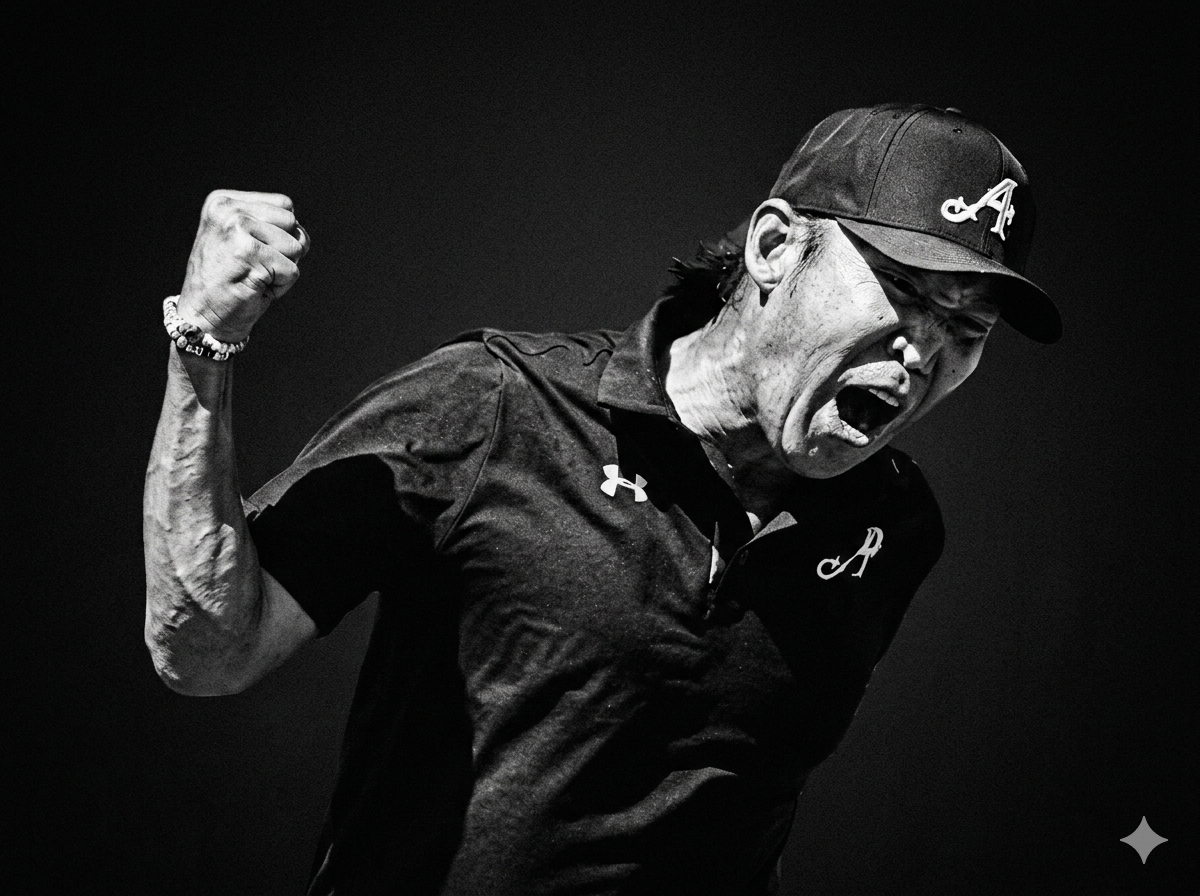
Why Golf Needed Anthony Kim Right Now
At the sport’s most fractured crossroads in a generation, a ghost came back from the dead and reminded us what we’d been missing all along.
I found Anthony Kim the way most people find things they weren’t looking for — down a rabbit hole at midnight, phone in hand, supposed to be sleeping. He’d launched a YouTube channel. No fanfare, no press release, just a quiet reappearance from one of the most mythologized disappearances in sports. I clicked play mostly out of nostalgia, the way you might revisit a song from your early twenties just to confirm it still sounds the way you remember. It did. But that’s not what stopped me cold.
What stopped me was what he said about being alone in a crowd. About the dark moments. About not remembering years of his own life. And sitting there, a few years into my own sobriety — having spent the better part of a decade playing golf only when I was drunk enough not to care how bad I was — I found myself rewinding the same thirty seconds over and over. Not because it was dramatic. Because it was recognizable.
This story isn’t about me. Kim’s story never needed my reflection to be powerful. But I offer that small sliver of context because it explains why I spent the next three days retracing his entire journey — the Ryder Cup heroics, the implosion, the silence, the crawl back — and why I came out the other side convinced of something: golf didn’t just get lucky that Anthony Kim came back. Golf needed him to.
The interview that started all of this: “The Journey Back | Anthony Kim with David Feherty” — roughly twenty minutes of honest conversation that most sports documentaries spend ninety trying to manufacture.
The Ghost in the Machine
To understand why Kim’s return matters, you have to understand the particular mythology that built up around his absence. Athletes disappear from sport all the time — injury, burnout, personal crisis. But most of them disappear with a statement, a press conference, a social media post. Anthony Kim just… stopped. He played his last event at the 2012 Wells Fargo Championship, withdrew after the first round citing an Achilles injury, and was never seen on a professional golf course again for twelve years.
In his absence, a mythology calcified. Message boards filled with theories — the infamous insurance payout story, whispers about a lifestyle that had spiraled beyond the control of anyone around him, speculation about injuries that went far deeper than a single tendon. Golf’s rumor mill, never exactly a model of restraint, went into overdrive. For a decade-plus, Anthony Kim existed less as a person than as a thought experiment: what might have been?
The reality, as it always does, turned out to be both simpler and more devastating than the myth. When he finally sat down with David Feherty in the video that launched his comeback narrative, Kim laid it out without any of the protective varnish that athletes usually apply to stories like this. The body was broken — shoulder surgeries, a hand surgery, a spinal fusion that Feherty cheerfully catalogued by dubbing him a “Franken-golfer.” But the body was almost a footnote.
“I’ve had some very dark moments. I’ve had some very low moments. I felt very alone, even when there’s a million people around. I needed to get my mind on straight and figure out what my purpose was on this planet.” — Anthony Kim, speaking with David Feherty, 2024
He talked about his “animal house” — rarely leaving home, watching reality TV, living with a menagerie that at one point included six dogs and two monkeys. He talked about having an “addictive personality” that could get “out of hand.” He talked about having “great times” that he literally doesn’t remember. And he talked about being surrounded by, as he put it, “scam artists” and “snakes living under his roof” — people who had taken advantage of a young man with too much money and not enough of a support structure to recognize the difference between friends and parasites.
What he didn’t say in that first Feherty interview — what he saved for a documentary and then eventually shared in a raw Instagram post — was the full depth of it. He had contemplated ending his life every day for nearly two decades. Even during the years when the world watched him make birdies at Augusta and pump his fist at Valhalla, he was using drugs and alcohol every single day. He got so good at hiding it that he lost track of who he actually was. As he put it himself, with the kind of bluntness that cuts through everything: “It’s f—in’ hard playing majors making porta potty stops every few holes.”
He eventually ended up in the ER for six days. It was there, according to his own account, that he made himself a promise: to do everything he could to make a difference. To show his daughter it’s never too late to keep trying. As of 2026, he has been sober for three years.
The Player He Was
To fully grasp what was lost — and what the game has been grieving, even if it didn’t know it — requires a brief reminder of who Anthony Kim was when he was right. Not just good. Right.
He turned professional in 2006 and announced himself almost immediately. By 2008, at twenty-two years old, he had won the Wachovia Championship and the AT&T National in the same season, climbed to sixth in the world rankings, and then done something at Valhalla that people in golf don’t easily forget. In the Sunday singles of the Ryder Cup, he walked out to face Sergio García — a veteran, a closer, a man who had been in these matches before — and beat him 5&4. He was twenty-three years old and he played like someone who had been told the secret.
The following year at the Masters, he set the record for most birdies in a single round with eleven. He went on to win a third tour event at the 2010 Shell Houston Open. And through all of it ran a style and an energy that the tour has rarely seen since — a cocky, joyful, sometimes infuriating swagger that was wholly his own. He wore his collar up. He brought a crowd. He played fast and he played hard and he played like every hole was personal.
Golf writer Oliver Wilson, who played against Kim in his prime, captured it well in the aftermath of Kim’s 2026 LIV Adelaide win: “I was lucky enough to play against AK in his prime and have never forgotten how he played golf… He had every shot in the bag and made it look so much fun. It was exactly how I wanted to play.”
The word that keeps coming up when people describe watching that version of Anthony Kim is fun. That is, in the context of professional golf, a surprisingly radical thing to say.
Golf’s Hollow Years
Here is the uncomfortable truth that professional golf has been dancing around for the better part of a decade: the sport has a charisma problem. Not a talent problem — the talent on tour right now is extraordinary by any historical measure. Not a viewership problem, exactly, since total PGA Tour prize money has never been higher. The problem is more fundamental and harder to fix with a television deal: golf has very few relatable icons left.
Tiger Woods was the sport’s north star for a quarter-century. He built the financial architecture of modern professional golf almost singlehandedly — PGA Tour prize money went from $70 million in 1996 to $280 million by 2008, tracking his dominance almost exactly. And yet for all his genius, Tiger was never particularly relatable. He may be the most non-relatable athlete in the history of sport. His whole brand was the impossible made real, which is a compelling thing to watch and a very hard thing to connect with. You don’t see yourself in Tiger Woods. You watch Tiger Woods the way you watch lightning.
Now Tiger is fifty years old, navigating his seventh back surgery and a ruptured Achilles, leaving his 2026 Masters participation an open question. The sport he rebuilt has a generation of extraordinary players — Scottie Scheffler, Rory McIlroy, Bryson DeChambeau — who are brilliant but, with perhaps the exception of Bryson’s eccentric mad-scientist reinvention of himself, somewhat hard to love in that specific, irrational, personal way that builds real fandom.
And then there is the war for the sport’s soul: the LIV-PGA fault line that has divided players, fans, broadcasters, and governing bodies into camps that sometimes feel less like sports arguments and more like geopolitical ones. The Saudi-backed LIV Golf circuit has money and spectacle; it also has legitimate reputational baggage that its critics are not wrong to raise. The PGA Tour has prestige and tradition; it also has a bureaucratic rigidity that has made it easier to condemn defectors than to ask why they were tempted in the first place. The result has been years of rancor that has served the lawyers and pundits far more than it has served the game itself.
Into all of this, Anthony Kim walked back through the door. Not with a press conference. Not with a manifesto about the future of the game. Just a wildcard spot on LIV and a swing that, in his own words, he hadn’t touched for most of a decade.
Bella, the ‘B’ on the Ball, and the Real Reason He’s Back
Before golf, there was Bella.
In the Feherty interview, Kim talks about becoming a father with a kind of quiet awe that doesn’t perform well but lands completely honestly. Doctors had told him that given what he had put his body through, he would not be able to have children. He describes the moment he found out he would be a father anyway as the turning point in his entire life — not the LIV contract, not the swing in his back garden, not the call from Greg Norman. Bella.
“She’s my everything… I feel so blessed to have this opportunity to be a dad.” — Anthony Kim, “The Journey Back” with David Feherty
He marks his golf balls with a ‘B’ and a heart for her, he explained, to calm his nerves on the course. He views golf now not as a career or a competition but as a platform — a way to be a role model, to show his daughter what it looks like to fight for something. The man who spent years unable to leave his own house now marks every tee shot with his daughter’s initial and tries to make it mean something.
When he won at LIV Golf Adelaide in February 2026 — shooting a bogey-free final-round 63 to beat Jon Rahm and Bryson DeChambeau in front of over 38,000 people, his first professional victory in 5,795 days — he walked off the 18th green and embraced his wife Emily and daughter Bella. When asked how he would celebrate, he said he might watch Frozen. He said he wanted to go see the kangaroos and koalas. He sounded like a man who had been given something he never expected to have and was trying very hard not to waste a second of it.
That’s not a PR narrative. That’s someone who went through the ER for six days and came out the other side and decided that if he was going to be here, he was going to actually be here.
The Comeback Nobody Believed In (Including Anthony Kim)
It is worth being honest about the early returns on the comeback, because the story would be dishonest without them.
When Kim made his first LIV start at Jeddah in March 2024, he finished last — 33 shots behind the winner, 56th out of 57 players. He later said he had only picked up a golf club about two and a half months before that first start. He admitted he was just trying “not to shank” the ball. He finished the entire 2024 season in 56th place and retained his spot only as a wildcard. In 2025, he finished 55th, got relegated, and had to earn his way back through LIV’s qualifying event in January 2026.
His detractors had a point. This was a man playing professional golf at a level that, under ordinary circumstances, would have seen him laughed out of a Monday qualifier. The only reason he had a field to play in was LIV’s exhibition structure. Golf Digest’s writers wrestled with this openly, noting the complicated moral and competitive geometry of the situation — that the same financial ecosystem with troubling geopolitical strings attached was the one that made space for a comeback the meritocracy of traditional golf could never have accommodated.
These are real tensions. They don’t resolve neatly. Kim’s win happened on a stage built by money that comes with serious questions. Adults can hold both truths at once: the achievement is genuine, and the context is complicated.
But what started happening in late 2025 made those arguments harder and harder to sustain. In November, he shot a bogey-free 64 at the PIF Saudi International — his lowest round since 2011 — and finished in a tie for fifth, his first top-10 in fourteen years. Something was clicking. The mantra he’d adopted — “1% better every day” — was actually showing up in the scorecard.
Then Adelaide.
“I don’t really know how to put it into words. I knew this was going to happen, but for it to actually happen is pretty insane. For anybody that’s struggling — you can get through anything.” — Anthony Kim, after winning LIV Golf Adelaide, February 2026
He received $4 million for his victory and jumped from 847th to 203rd in the world rankings. Social media, for one afternoon, forgot that it was supposed to be angry about golf. Luke Donald, who has no connection to LIV, posted: “Redemption stories always resonate… We all fail at times. Not everyone has the courage to come back, face it, and rebuild.” A fan who described himself as a PGA loyalist who had never connected with the LIV product wrote: “If anyone tries to downplay what Anthony Kim just did, shame on you. This is one of the greatest comebacks in the history of sports.”
He wasn’t wrong.
The Relatable Icon Golf Has Been Waiting For
Golf has always struggled to make itself feel like it belongs to regular people. The courses cost too much. The gear costs too much. The culture, for most of its history, has been actively hostile to anyone who doesn’t fit a very specific demographic profile. The people who love the game have spent decades fighting that perception, and some real progress has been made. But the cultural gap between the golf that gets televised and the golf that actually gets played by most people remains significant.
What Anthony Kim offers is something the sport’s current elite, for all their talent, genuinely cannot: a story that connects. Not because it’s dramatic — though it is. Not because it’s an underdog tale — though it’s that too. But because it’s true in the way that the best sports stories are true: it happened to a real human being who broke, and recovered, and came back changed.
Most golfers — recreational or otherwise — know something about the game as punishment. About rounds played under conditions that had nothing to do with the scorecard. About using the four hours on the course to escape something or numb something or hide from something. Golf is uniquely suited to that kind of displacement, which is part of why it’s always attracted people in the grip of things they can’t quite name.
Anthony Kim is the first high-profile professional golfer to stand up and say: yes, that was me too, and here is what it actually costs, and here is what’s on the other side of it. Not as a motivational poster. As a forty-year-old man with metal in his spine who shot a 63 on Sunday and watched Frozen afterward because his daughter loves it.
That is a thing the sport has been missing. Post-Tiger, the dominant emotion around golf’s elite has been admiration — awe, occasionally envy, sometimes frustration. What it has rarely produced is genuine identification. The sense that a professional golfer is living something you understand. Kim produces that. Not universally — no one does. But for anyone who has ever used the game as a place to disappear, who lost their love for it somewhere in the haze of what they were really running from, who is now finding their way back to it with clearer eyes: Kim is the first person in this sport in a long time who makes the game feel like it might actually be for you.
Two Men, One Cup of Coffee
The Feherty interview ends with a small moment that I keep coming back to. Kim and Feherty — two men who have both, in their different ways, been on the floor and chosen to get up — decide at the end of the conversation to go get a cup of coffee instead of going to the bar. It’s a tiny thing. It’s played for mild humor. But watch the exchange and you’ll understand why it lands so hard if you know what it represents.
Recovery doesn’t look like an intervention scene or a rock bottom montage. It mostly looks like small daily choices that nobody notices except you. It looks like coffee instead of a drink. Like a ‘B’ and a heart on a golf ball. Like picking up a club two and a half months before your first tournament and trusting the work you put in even when the scoreboard says otherwise. Like waking up every day and being 1% better.
Golf needed Anthony Kim right now because the sport is at a crossroads and it needed a reminder of what actually matters at the center of it — not the money, not the politics, not the tour allegiances. The game. The love of the game. The possibility, which Kim had written off entirely and has now reclaimed against every reasonable expectation, that it might be worth playing for its own sake.
He told Feherty: “I don’t think I ever loved golf. What’s very weird to me is I’m falling in love with the game.” For a sport still searching for its post-Tiger identity, that might be the most important sentence anyone has said about professional golf in years. Not because of what it says about strategy or scheduling or PGA-LIV peace talks. Because it says something true about why any of us play this infuriating, beautiful, punishing, transcendent game in the first place.
You can fall in love with it. Even after everything. Even after all the dark moments and the lost years and the long way back. You can fall in love with it like it’s new.
Anthony Kim already has. The rest of us are catching up.
Watch “The Journey Back | Anthony Kim with David Feherty” on YouTube — the full interview that started this story.

Author: Carter Davies
Music, Travel and Sobriety writer for Sober Standard. More articles can be found here and on X https://soberstandard.com/profile/carter-davies/

Leave a Reply